
North Carolina Motorcycle Insurance: Three Things Worth Checking Before Fall Riding Season

September is when riding in North Carolina finally gets good. The humidity breaks, the hardwoods start to turn, and the two-lane roads west of the Triangle stop feeling like a convection oven. It is also, for most riders, the last time anybody thinks about their motorcycle policy until spring.
That is worth interrupting this year. The rules underneath that policy changed on July 1, 2025, and plenty of riders are carrying a declarations page they have not read since before the change.
What actually changed on July 1, 2025
Two things, both from the North Carolina Department of Insurance.
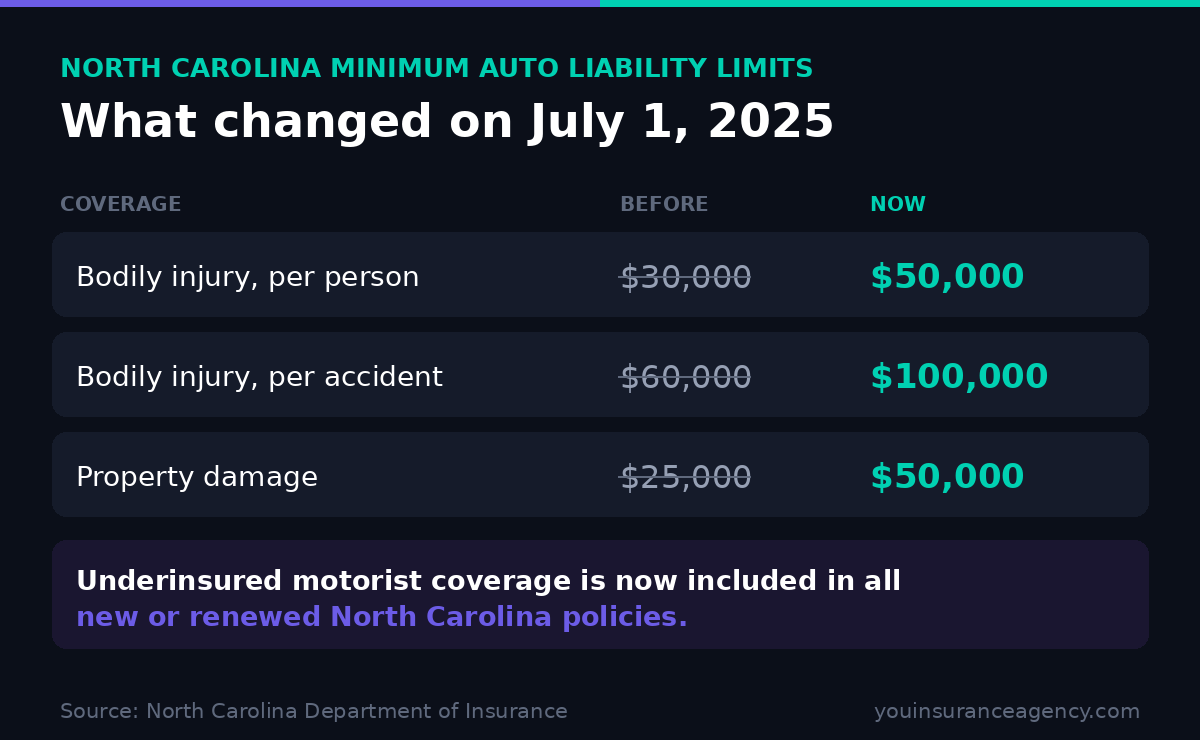
First, the state’s minimum liability limits went up. Bodily injury minimums moved to $50,000 per person and $100,000 per accident, and property damage moved to $50,000. The old floor was $30,000 / $60,000 / $25,000.
Second — and this is the one riders should care about — underinsured motorist coverage is now included in all new or renewed policies. It used to be something you had to reach for at minimum coverage levels. Now it comes standard.
The NCDOI also spelled out how that coverage now behaves. Eligibility is measured against the total damages a person sustained, rather than by comparing limits at the time of the accident. Underinsured motorist coverage cannot be reduced by a setoff or credit against other coverage, with workers’ compensation as the exception. And where more than one policy applies, the total available is the sum of the highest limit under each policy.
Check one: whether your underinsured motorist limit is sized for a motorcycle
Here is the uncomfortable arithmetic. A driver carrying the new state minimum brings $50,000 of bodily injury coverage per person to the table. A rider who goes down at 45 miles an hour and needs surgery, a hospital stay, and time off work can pass $50,000 well before the first follow-up appointment.
When the at-fault driver’s limit runs out, underinsured motorist coverage is what stands between you and the rest of the bill. That is true in a car too. On a bike, the injuries tend to be the kind that exhaust a minimum limit quickly.
Worth doing this week: pull your declarations page and find the UIM line specifically — not the liability line. If it is sitting at the state floor, that should be a decision you made on purpose, not one that happened by default.
Check two: the parts of the bike that are not the bike
North Carolina requires liability. Everything past that is optional, and on a motorcycle “optional” covers a lot of ground:
- Custom parts and accessories — exhaust, bars, seat, luggage, paint, anything added after it left the showroom floor
- Safety apparel — helmet, jacket, boots, gloves
- Passenger coverage, if you ever carry one
- Medical payments, which the NCDOI describes as paying reasonable and necessary medical and funeral expenses after an accident
- Collision and comprehensive
The state’s own consumer guide is direct about this: it “is not a substitute for your policy contract.” That is the honest answer. Whether your accessories and your gear are covered, and up to what dollar figure, is written into your specific policy, not into state law. Most riders assume more is covered than actually is. Reading the schedule is the only way to know.
Check three: what you do when the bike goes in the garage
The instinct at the end of riding season is to strip the policy back to save money over the winter. Think it through before you do.
A parked motorcycle does not crash, but it can still be stolen, catch fire, take a falling limb, or sit in a storage unit that floods. Those are comprehensive claims, and comprehensive is the piece that keeps working while the bike sits still.
There is a second wrinkle. A gap in coverage is a gap in coverage, and continuous coverage history is something insurers look at. Dropping a policy for five months can cost more the following spring than it saved over the winter. If winter storage is on your mind, it is a better conversation in October than in December.
The ten-minute version
- Pull your declarations page. Most carriers let you download it from their app in under a minute.
- Find the underinsured motorist limit and decide whether it is where you want it.
- Look for accessories, safety apparel, and passenger coverage — and note the dollar limits, not just whether the line exists.
- Check your renewal date. If your policy renewed after July 1, 2025, the new rules already applied.
- If any of it reads like another language, ask a licensed agent to go through it with you. Declarations pages are written for adjusters, not for riders.
We write motorcycle coverage for riders across North Carolina, and more of these conversations start with “I honestly do not know what I have” than you would guess. There is no shame in that. If you want the longer version of how motorcycle coverage works in this state, it is on our motorcycle insurance page, and if it makes sense to look at the car in the driveway at the same time, start with auto insurance.
Sources
- NC Department of Insurance — Changes to the Rating of Automobile Insurance Policies, Effective July 1, 2025
- NC Department of Insurance — Motorcycle Insurance
- NC Department of Insurance — A Consumer’s Guide to Insuring Your Motorcycle
This article is general information about how coverage works in North Carolina. It is not advice about your specific policy. Coverage terms, limits and availability vary by policy — check your own declarations page or talk with a licensed agent before making a change.
When did you last have your auto policy checked?
Rates move, and the carrier that priced best for you two years ago may not be the one that prices best now. Send us what you have and we’ll tell you honestly whether it’s still the right policy.
You Insurance Agency · Garner, NC · right next door to the Post Office · Auto · Home · Life · Commercial