
Deer Season on Wake County Roads: What Your Auto Policy Actually Covers
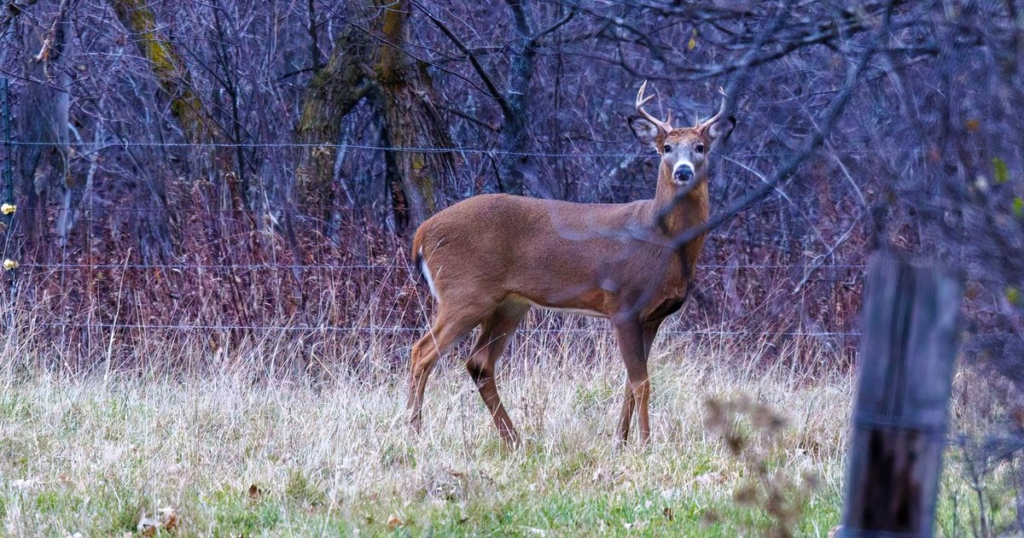
You know the stretch. Two lanes, a tree line right up against the shoulder, a wire fence, and grass tall enough to hide a deer standing broadside until your headlights are on top of it. Around Garner there are dozens of them — Ten-Ten Road after dark, the wooded pockets off Old Stage and Timber Drive, half the back roads running toward Clayton. From October into December, that is exactly where deer are moving, and exactly when most drivers find out what their auto policy does and does not cover.
Wake County leads North Carolina, and Garner sits on the county line
The N.C. Department of Transportation tracks animal-related crashes by county. Over the three years from 2022 through 2024, Wake County recorded 2,676 of them with 116 injuries — more than any other county in the state. Johnston County came in tenth with 1,365 crashes. Garner straddles that line, which means local drivers are commuting through the number one and number ten counties on the same trip to work.
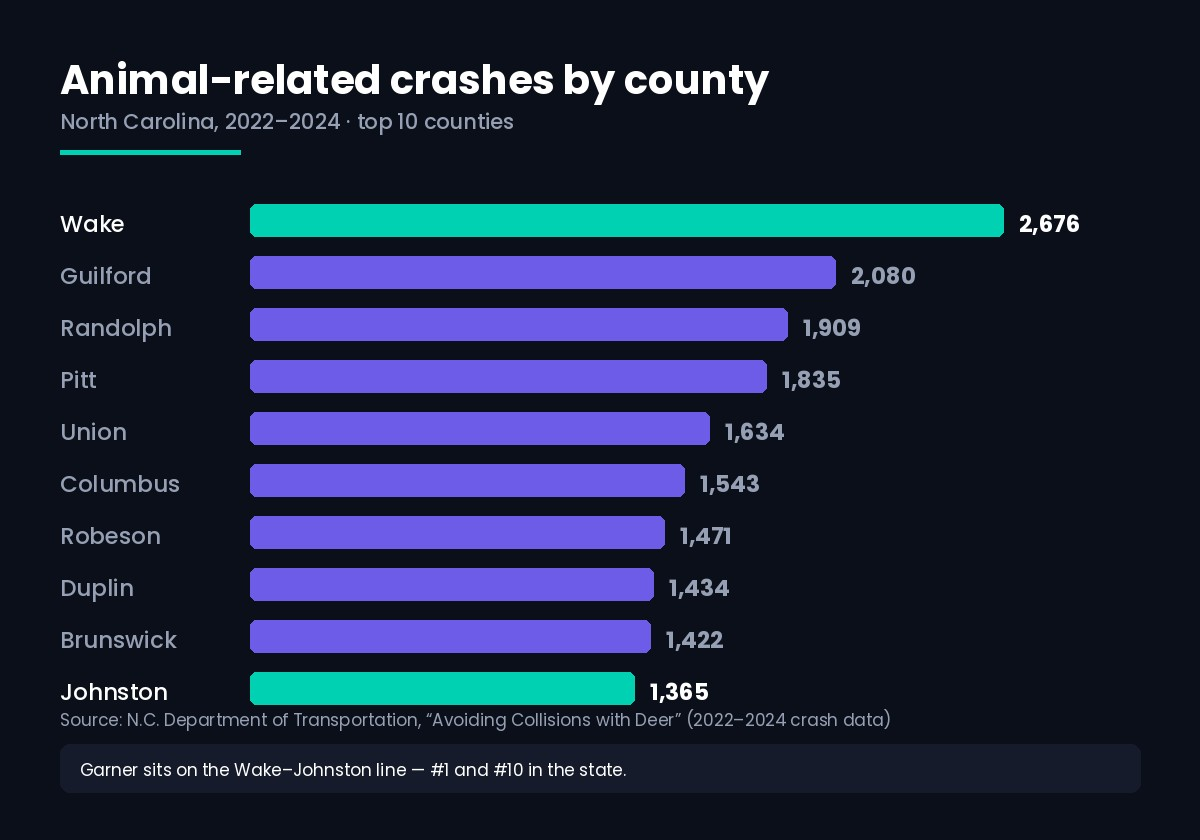
Statewide, NCDOT reports that about 8 percent of all vehicle crashes involve an animal strike. Across just those top ten counties, the three-year total came to 17,369 crashes, 686 injuries, three deaths and close to $58 million in damage. Researchers at the UNC Highway Safety Research Center found the same seasonal shape in the data: in 2020, more than half of North Carolina’s deer-related crashes happened in October, November and December, with almost a quarter in November alone. More than four out of five happened between 6 p.m. and 8 a.m.
That is the whole story in one line. Dark, cool months, evening and early-morning drives, roads with cover on both sides. September is the month to sort your coverage out, because November is not.
Hitting a deer is usually a comprehensive claim, not a collision claim
This trips up a lot of people, and the wording is genuinely counterintuitive. The N.C. Department of Insurance lists “contact with a bird or animal” as a comprehensive loss — the same bucket as fire, theft, hail, falling objects and broken glass. Comprehensive is also called “other than collision” coverage. Collision coverage, by NCDOI’s definition, is damage from impact with another vehicle or an object such as a tree or a sign.
So the deer that walks into your front quarter panel is generally comprehensive. Both coverages come with a deductible you pay before the insurer pays anything, and the two deductibles are often set at different amounts on the same policy. It is worth pulling up your declarations page and looking at what each one actually says.
Here is the part that matters most: North Carolina requires you to carry liability coverage and uninsured/underinsured motorist coverage. As of July 1, 2025, the required liability minimum is 50/100/50 — $50,000 per person and $100,000 per accident for bodily injury, and $50,000 for property damage. Comprehensive is not on the state’s required list. It is coverage you choose to carry. A driver running a liability-only policy on a paid-off truck has no coverage for the deer at all, and usually finds that out in a body shop parking lot in November.
The swerve is what turns it into someone else’s claim
NCDOT’s guidance is blunt: do not swerve to avoid a collision. Brake hard, stay in your lane, take the hit. The reason is partly physics — swerving at highway speed is how a deer strike becomes a rollover or a head-on — and partly insurance.
If you swerve and hit a mailbox, a ditch, a guardrail or an oncoming car, you are no longer in comprehensive territory. Damage to your own vehicle becomes a collision claim, and damage to anyone else becomes a liability claim against your policy — where those 50/100/50 limits are the floor, not a ceiling. North Carolina also applies contributory negligence, which NCDOI describes plainly: if you contribute to an accident, you may not be able to collect on a liability claim. That is a harder rule than most states use, and it is worth understanding before you need it.
For riders, the calculus is different again. A deer strike on two wheels is not a fender repair, and it is worth reviewing your motorcycle coverage before the fall riding season gets going. Drivers who want liability protection above the state minimums should look at how an umbrella policy sits on top of an auto policy.
What to do in the ten minutes after you hit one
- Get the vehicle off the travel lane if it will move, and put the hazards on. A stopped car on a dark two-lane road is the second crash waiting to happen.
- Call the police. NCDOI’s own accident checklist says to call, particularly where there are injuries. A report also gives your claim a date, a location and an official description that nobody has to reconstruct from memory later.
- Do not touch the deer. NCDOT is explicit about this — an injured deer can hurt you badly. Call 911 and let them handle it.
- Photograph everything before anything moves. All four corners of the vehicle, the damage close up, the road, the tree line, the animal, and a wide shot showing where you ended up.
- Check for a second deer. They travel in herds, and the one you did not see is often still crossing.
- Call your agent, not just the claims line. Someone who can look at your actual declarations page can tell you which deductible applies and whether you have coverage for a rental while the car is in the shop — that is rental reimbursement, a separate coverage from comprehensive.
Three things worth checking on your policy this month
None of this is advice about your specific policy — but these are the three lines most people have never actually read. First, do you carry comprehensive at all, on every vehicle? A second car or an older truck that got dropped to liability-only years ago is the usual gap. Second, what is the comprehensive deductible? If it is set high enough that you would hesitate to file a claim for a bumper and a headlight assembly, the coverage is not doing what you think it is doing. Third, do you have rental reimbursement? Deer damage tends to mean a bumper, a headlight assembly, a fender and a week or more of parts.
If you are not sure what is on your policy, that is normal, and it is a five-minute conversation. You can start with our auto insurance page, or just ask a licensed agent to read your declarations page with you. For anyone shopping auto insurance in Garner, NC or anywhere in the Triangle, the fall is the right time to have that conversation — not the week after.
Sources
- N.C. Department of Transportation, Avoiding Collisions with Deer (2022–2024 crash data by county)
- UNC Highway Safety Research Center, NC Deer-related Crashes Increase in the Fall
- N.C. Department of Insurance, Basic and Miscellaneous Auto Coverages
- N.C. Department of Insurance, Automobile insurance: What’s covered and what isn’t
- N.C. Department of Insurance, After an Accident
- N.C. Department of Insurance, Changes to the Rating of Automobile Insurance Policies, Effective July 1, 2025
This article is general information about how coverage works in North Carolina. It is not advice about your specific policy. Coverage terms, limits and availability vary by policy — check your own declarations page or talk with a licensed agent before making a change.
When did you last have your auto policy checked?
Rates move, and the carrier that priced best for you two years ago may not be the one that prices best now. Send us what you have and we’ll tell you honestly whether it’s still the right policy.
You Insurance Agency · Garner, NC · right next door to the Post Office · Auto · Home · Life · Commercial