
Your Third Hire Changes the Rules: Workers’ Comp and the North Carolina Small Business
A landscaping outfit off Timber Drive in Garner runs one truck and one trailer. The owner does the estimates and drives, his brother runs the mower, and in March they bring on a third man for the spring rush. Nothing about the business feels different that week. Legally, it is.
North Carolina sets its workers’ compensation threshold by headcount, and the count is not always the one an owner keeps in his head. Here is how the rule works, who it skips, and what the statute says happens when a business gets it wrong.
The line is three employees — and officers count
The North Carolina Industrial Commission puts it plainly: “In general, any employer who employs three or more employees must have workers’ compensation insurance coverage or qualify as a self-insured employer.” The Commission describes the Act as covering businesses employing three or more people on a regular basis. That is a test about regularity, not full-time hours, so part-time and seasonal help can put a business over the line.
The part that surprises people is who gets counted. Under the Act, “every executive officer selected or appointed and empowered in accordance with the charter and bylaws of a corporation is considered an employee of such corporation.” So a corporation with two officers and one hourly worker has three employees, even though the owners would never describe themselves that way. For a non-profit, volunteer officers count toward the three as well.
There is one exception that ignores headcount entirely. Work involving the use or presence of radiation requires coverage if one or more employees perform those activities — one employee, not three.
Who the Act leaves out
G.S. 97-13 sets out the exceptions. The ones a small business in Wake or Johnston County is most likely to run into:
- Casual employees — work that is not in the usual course of the business
- Domestic servants
- Farm laborers, when fewer than 10 full-time nonseasonal farm laborers are regularly employed
- Federal government employees in North Carolina
Sole proprietors, partners and LLC members are not automatically counted as employees, though they may elect to be covered. Corporate officers may exclude themselves by policy provision — but excluding an officer from coverage does not remove that officer from the headcount that triggers the requirement in the first place. Those are two separate questions, and mixing them up is an expensive mistake.
Worth saying out loud, too: labeling a worker a contractor rather than an employee is not a decision the paperwork makes on its own. The Industrial Commission runs a Criminal Investigations & Employee Classification Division, and classification is exactly what it looks at.
The subcontractor certificate almost nobody remembers
This is the section that catches general contractors, builders and anyone who hires out a piece of a job. Under G.S. 97-19, before a principal or intermediate contractor sublets any contract for work, it must obtain a certificate issued by the subcontractor’s workers’ compensation carrier — or, for a self-insured subcontractor, a certificate of compliance issued by the Department of Insurance.
Sublet the work without that certificate and one of the sub’s employees gets hurt, and the contractor can be the one paying the compensation. The statute gives two ways out: the subcontractor actually had an active policy on the date of injury, whether or not the certificate was obtained on time; or the policy had lapsed before the injury but the contractor had obtained the certificate beforehand and did not know about the expiration or cancellation.
The practical version: get the certificate before the crew shows up, and put the expiration date on a calendar. A certificate collected in January does nothing for a job in November if the policy died in June.
What the statute says it costs to be wrong
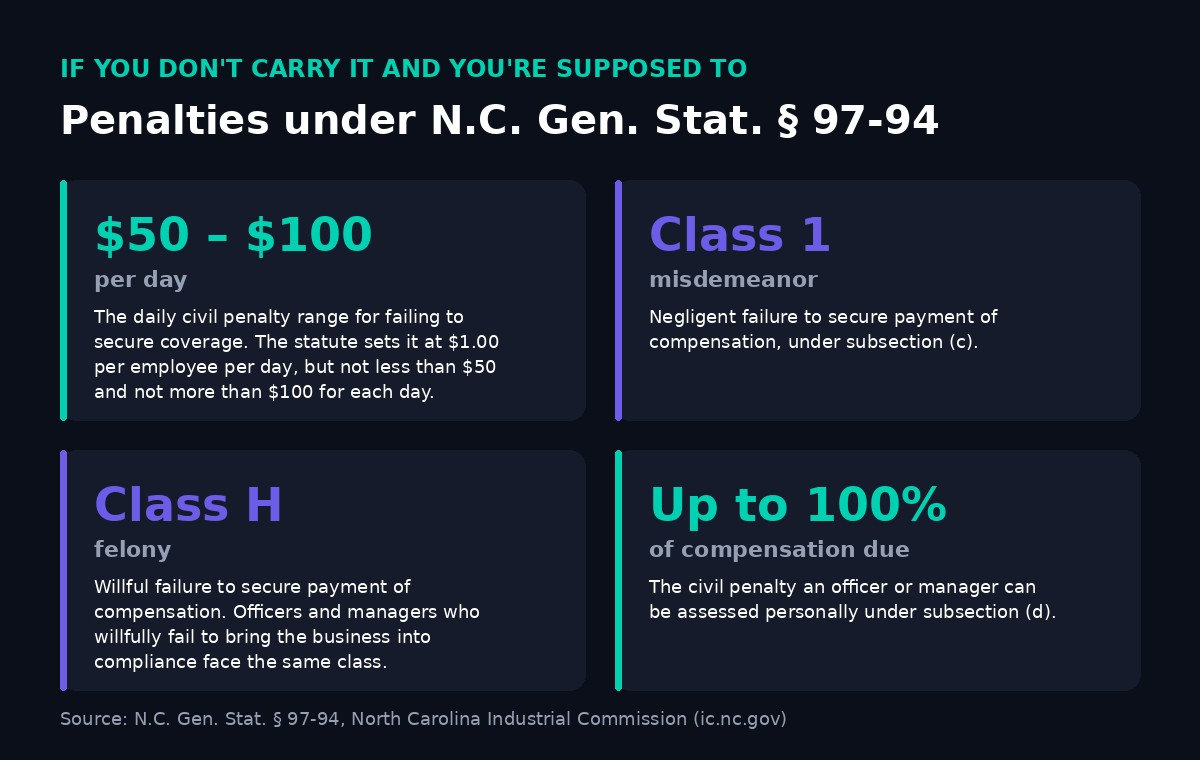
G.S. 97-94 sets a civil penalty of $1.00 for each employee for every day of noncompliance, but not less than fifty dollars ($50.00) and not more than one hundred dollars ($100) for each day, continuing until the failure ceases. That is per day, not per incident, and it runs from the day the business should have had coverage.
Beyond the civil penalty, the statute makes negligent failure to secure payment of compensation a Class 1 misdemeanor and willful failure a Class H felony. Subsection (d) reaches individuals: an officer or manager who willfully fails to bring the employer into compliance is guilty of a Class H felony, negligent failure is a Class 1 misdemeanor, and that individual may be assessed a civil penalty of up to one hundred percent of the compensation due.
If the voluntary market says no
A business with a rough loss history or an unusual operation is not stuck. The North Carolina Rate Bureau administers the assigned risk market, which exists so employers who cannot get coverage through standard carriers can still meet the requirement.
Classification matters more than most owners realize. The Department of Insurance notes North Carolina uses roughly 600 employer classifications for rating, and that carriers weigh things like employee training, first aid, safety promotion, housekeeping, material handling and protective equipment. If the payroll on a job is coded to the wrong class, the number that comes back is not describing the business that actually exists.
Hiring also changes what happens on the road
Workers’ compensation is not the only coverage that shifts the day a business adds people. Once an employee is driving — a company truck, or their own car to a job site — how that exposure is handled is worth a specific conversation, because personal auto policies and business use do not always line up the way owners assume.
The underlying auto numbers changed recently, too. Effective July 1, 2025, North Carolina’s minimum liability limits rose to $50,000 per person and $100,000 per accident for bodily injury, and $50,000 for property damage. Underinsured motorist coverage is now automatically included in new and renewed policies.
What to actually do before the next hire
- Count the way the Act counts. Add corporate officers to the hourly and salaried headcount, then check whether anyone falls under a G.S. 97-13 exception.
- Collect a certificate from every subcontractor before work begins, and diary the expiration date so a lapse does not become the contractor’s problem.
- Pull the class codes on the current policy and read them against what the crews actually do all day.
- Write down who drives, what they drive, and whose vehicle it is, then get that in front of an agent before it is a claim question.
- Revisit the picture when headcount changes, not at renewal. The threshold moves the day the third person starts, not on the policy anniversary.
If you are working through what a growing crew needs, our commercial insurance page walks through how business coverage is put together in North Carolina. For the driving side, the auto insurance page covers how the new state limits work, and if a judgment could reach past a business or personal policy limit, umbrella insurance is the layer that sits above both. A licensed agent can look at your actual declarations pages and tell you where the gaps are.
Sources
- North Carolina Industrial Commission — Workers’ Compensation Insurance Requirements
- North Carolina Industrial Commission — Frequently Asked Questions
- N.C. Gen. Stat. § 97-94 — Penalty for failure to secure payment of compensation
- N.C. Gen. Stat. § 97-19 — Liability of principal contractors
- N.C. Gen. Stat. § 97-13 — Exceptions from provisions of Article
- NC Department of Insurance — Workers’ Compensation
- North Carolina Rate Bureau — Assigned Risk Market
- NC Department of Insurance — Changes to the Rating of Automobile Insurance Policies, Effective July 1, 2025
This article is general information about how coverage works in North Carolina. It is not advice about your specific policy. Coverage terms, limits and availability vary by policy — check your own declarations page or talk with a licensed agent before making a change.
Is your business actually covered for what you do?
General liability, workers’ comp, commercial auto, cyber — the gaps usually show up in the details. We’ll review what you carry now and flag what’s missing before a claim does.
You Insurance Agency · Garner, NC · right next door to the Post Office · Auto · Home · Life · Commercial