
Flood Insurance Won’t Pay for Your Flooded Car in North Carolina. Here’s What Does
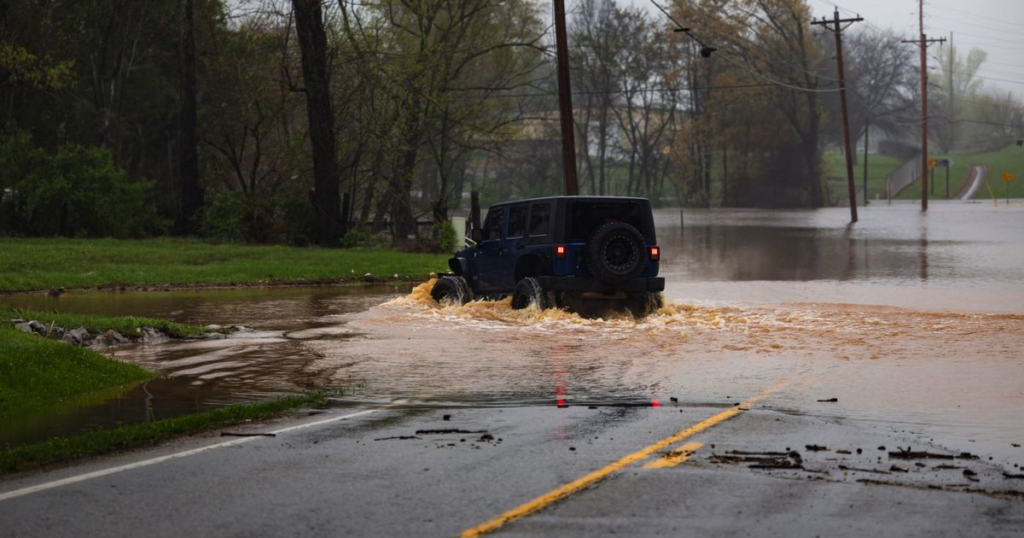
A flooded car in Wake County almost never starts with a hurricane. It starts with a creek you drive over every day without thinking about it.
Garner and south Raleigh sit in a web of small creeks. After a few inches of rain in a short window, the low spots go under — a dip in the road, the back corner of a shopping center lot, the underpass you take to skip a light. The water comes up, sits for an hour, and drains off. The car it got into is a different story.
The Atlantic hurricane season officially runs June 1 through November 30, so there are two months left on the calendar. But the coverage question below works the same way during a quiet October rainstorm as it does during a named storm, and most people get it wrong in the same direction.
A flood policy stops short of the driveway
This is the part that surprises people. A National Flood Insurance Program policy is written for the building and what is inside it. The standard form excludes “most self-propelled vehicles such as cars, including their parts.” The NFIP Dwelling Form goes up to $250,000 on the building and up to $100,000 on contents, and the car sitting in the driveway is in neither bucket.
The homeowners policy is not the backstop either. The North Carolina Department of Insurance states it directly: “Water damage due to flood is specifically excluded from coverage under the homeowner’s policy.”
So the house has one answer and the belongings inside have another, and the vehicle in the driveway has neither.
Comprehensive is the part of the auto policy that deals with water
NCDOI puts the vehicle side just as plainly: “The ‘comprehensive’ section of the automobile policy provides coverage for damages due to flood.”
That matters because comprehensive is optional in North Carolina. Liability pays for damage you do to someone else — it has never paid for your own car, flooded or otherwise. If a lender holds the title, comprehensive is usually required by the loan. A paid-off car is exactly where people drop it to trim the premium, and then forget they did.
Worth doing this week: pull out your declarations page and look for a comprehensive line with a deductible next to it. If there is no comprehensive line, or it reads “not covered,” you have your answer in about ten seconds. If it is there, note the deductible, because that number comes off any flood claim on the vehicle. Terms and exclusions vary by policy, so read your own or ask a licensed agent to read it with you.
Six inches is the number worth remembering
The National Weather Service publishes the thresholds, and they are lower than almost anyone guesses.
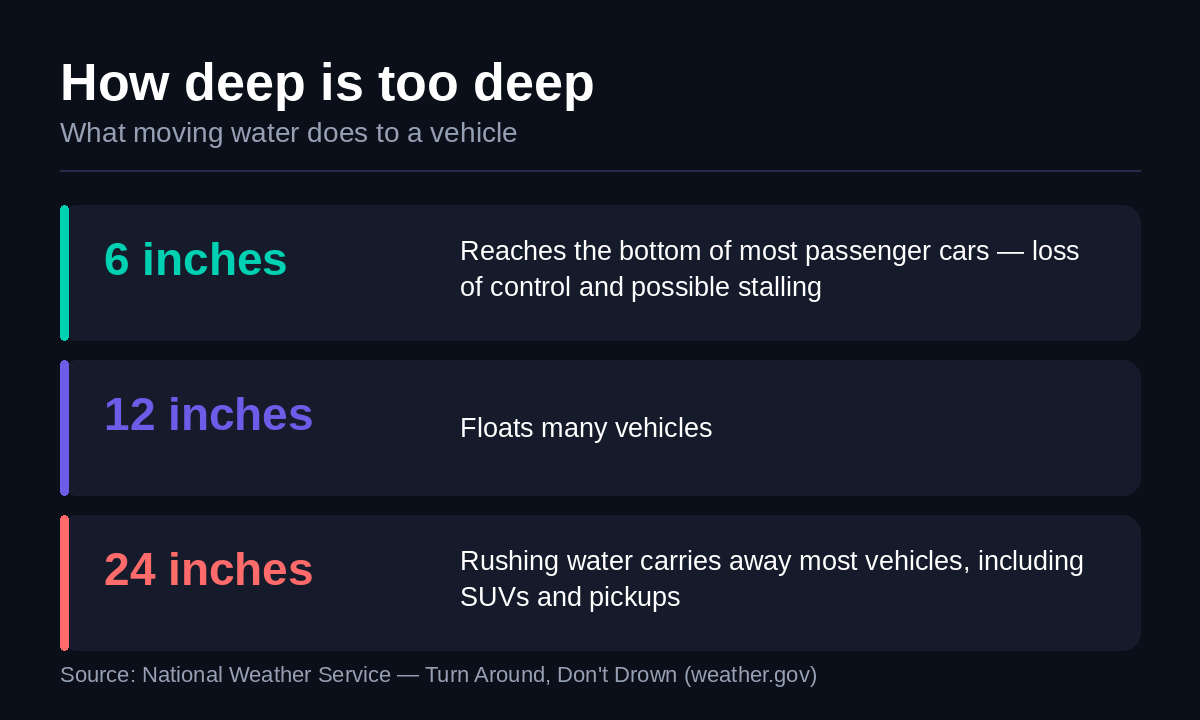
Six inches of water reaches the bottom of most passenger cars, causing loss of control and possible stalling. A foot of water floats many vehicles. Two feet of rushing water carries away most vehicles, including SUVs and pickups. The NWS also reports that over half of all flood-related drownings happen when a vehicle is driven into hazardous flood water.
A truck sitting higher than a sedan buys you less margin than it looks like it does. And no insurance policy, however it is written, gets the car back out of the water for you.
In North Carolina, a flooded car leaves a paper trail
NCDMV defines a flood vehicle as “a motor vehicle that has been submerged or partially submerged in water to the extent that damage to the body, engine, transmission or differential has occurred.” A salvage vehicle is one damaged to the extent that repairs would exceed 75 percent of its fair market value. When an insurance company pays a claim on a salvaged vehicle in North Carolina, NCDMV has to be notified within 10 days.
On the resale side, state law has teeth. Under G.S. 20-71.4(a)(2), a seller who knows a vehicle is or was a flood vehicle, a reconstructed vehicle, or a salvage motor vehicle must disclose that in writing before the transfer. There is no model-year limit on that one — it applies to a 2024 and a 1996 alike. The separate collision-damage disclosure in (a)(1), which kicks in when repair cost exceeded 25 percent of fair market retail value, is the one capped at vehicles up to and including five model years old. A violation of either is a Class 2 misdemeanor.
If you are shopping for a used car this fall
Flood cars travel. They get cleaned up, retitled somewhere else, and show up on a lot three states away looking fine. The U.S. Department of Justice runs the National Motor Vehicle Title Information System for exactly this reason: insurance carriers, auto recyclers, junk and salvage yards, and states are required to report into it, and DOJ reports that 87 percent of the country’s DMV data is represented. Consumers can run a VIN through a provider at vehiclehistory.gov.
Then use your nose and your hands. Damp or heavily perfumed carpet, silt in the spare tire well and under the seats, a faint tide line inside the trunk or door jambs, rust on seat rails and bolt heads that should be clean, moisture beading inside the headlights, and electronics that act strange on a test drive are all worth a second look — and a written damage disclosure before money changes hands.
What to actually do
- Pull your auto declarations page and confirm whether comprehensive is on each vehicle, and what the deductible is.
- While it is in front of you, check your liability limits. Effective July 1, 2025, North Carolina’s minimum auto liability is $50,000 per person and $100,000 per accident for bodily injury, plus $50,000 property damage, and underinsured motorist coverage is now included in new and renewed policies.
- Name the two low spots on your own commute before it rains. Six inches is not a lot of water, and most drivers cannot judge depth from the driver’s seat at night.
- When heavy rain is in the forecast, do not park in the low corner of the lot or the bottom level of a deck.
- If water does get into a vehicle, resist the urge to start it, photograph it where it sits before anything is moved or towed, and call your agent before you authorize repairs.
- Buying used: run the VIN through vehiclehistory.gov and ask for the written damage disclosure the statute requires.
Where this connects to the rest of your coverage
Flooding is the clearest example of a risk that sits across three different policies at once. The vehicle side lives on your auto insurance policy, under comprehensive. The building and the belongings inside it live on a separate flood insurance policy, because your home insurance policy excludes flood outright. Knowing which one answers which question is most of the work.
Sources
- FEMA, National Flood Insurance Program Summary of Coverage (hosted by NCDOI) — ncdoi.gov/nfip-summarycoverage/open
- NC Department of Insurance, Flood Insurance FAQs — ncdoi.gov/flood-insurance-faqs/open
- National Weather Service, Turn Around Don’t Drown — weather.gov/tsa/hydro_tadd
- NCDMV, Salvaged and Abandoned Vehicles — ncdot.gov
- N.C. General Statutes § 20-71.4, Failure to disclose damage to a vehicle — ncleg.gov
- U.S. Department of Justice, National Motor Vehicle Title Information System — justice.gov
- NOAA NESDIS, Atlantic hurricane season dates — nesdis.noaa.gov
- NC Department of Insurance, “Changes to the Rating of Automobile Insurance Policies, Effective July 1, 2025” (ncdoi.gov)
This article is general information about how coverage works in North Carolina. It is not advice about your specific policy. Coverage terms, limits and availability vary by policy — check your own declarations page or talk with a licensed agent before making a change.
When did you last have your auto policy checked?
Rates move, and the carrier that priced best for you two years ago may not be the one that prices best now. Send us what you have and we’ll tell you honestly whether it’s still the right policy.
You Insurance Agency · Garner, NC · right next door to the Post Office · Auto · Home · Life · Commercial