
Storing Your Motorcycle for Winter in North Carolina? Turn In the Tag Before You Cancel

Every October the same thing happens in garages from Garner to Clayton. The mornings get cold, and somebody does the math: why pay for insurance on a motorcycle that is going to sit under a cover until March? So they call and cancel the policy. Then in February a letter shows up from the N.C. Division of Motor Vehicles with a civil penalty on it, and the savings are gone.
It is one of the most common and most avoidable mistakes riders make in North Carolina. The rule that catches people has nothing to do with whether the bike moves. It has to do with whether the tag is still on it.
North Carolina ties the insurance to the plate, not to the riding
Under N.C. General Statute 20-309, “the owner of each motor vehicle registered in this State shall maintain financial responsibility continuously throughout the period of registration.” A motorcycle with a valid North Carolina plate is a registered motor vehicle. There is no seasonal exception, no winter pause, and no allowance for a bike sitting on a battery tender in a locked garage.
The statute also spells out what happens when the coverage stops: the owner “shall forthwith surrender the registration certificate and plates of the vehicle” to NCDMV. NCDMV puts the same thing in plainer language on its insurance requirements page — cancel your insurance only after you have turned in the plate, because “canceling insurance before returning the license plate will result in a fine for failure to maintain continuous insurance coverage.”
One more detail that surprises riders: the statute defines financial responsibility as a liability policy, a financial security bond, a security deposit, or self-insurance. Comprehensive coverage on its own is not on that list. Dropping the liability portion over the winter and keeping comprehensive so there is still some coverage on the bike while it sits does not satisfy the requirement as long as the plate is still active.
What a lapse actually costs
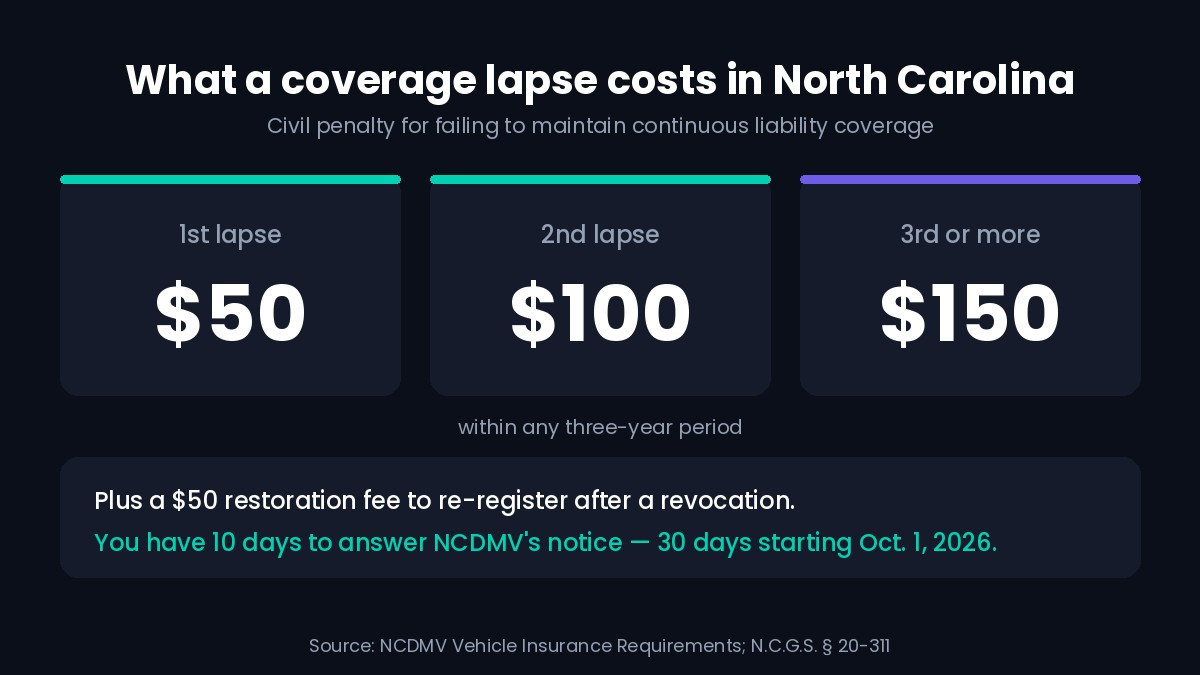
When a carrier reports the termination, NCDMV sends a liability insurance termination notice to the registered owner. If the coverage really did lapse, the civil penalty under G.S. 20-311 depends on how many lapses you have had in the previous three years: $50 for the first, $100 for the second, $150 for the third or more. If the registration is revoked and you later want the bike back on the road, there is also a $50 restoration fee.
The penalty is the small part. A revoked registration is a headache to unwind in the spring, and a lapse on your record follows you into the next renewal.
The deadline to answer that notice changes on October 1
This one is worth writing on the calendar. Right now, a registered owner who gets a termination notice has 10 days from the date printed on the notice to respond. NCDMV states that effective October 1, 2026, that window becomes 30 days.
Ten days is not much when the notice goes to an address you moved away from two years ago. Thirty is a real cushion — but it is still a window, and it starts running on the date printed on the letter, not the date you open it.
If the coverage never actually lapsed — a policy moved from one company to another, or a renewal processed late — the fix is not an argument with DMV. Your insurance company electronically submits a Certificate of Insurance, the FS-1, showing continuous coverage. When NCDMV receives it, the records get corrected and the fine clears.
If you really are putting the bike away for good this season
Turning in the tag is a legitimate move, and it is the correct order of operations if you genuinely will not ride until spring and you would rather not carry the registration. NCDMV accepts plates in person at any license plate agency, or by mail to the NCDMV Vehicle Registration Section, Renewal Title and Plate Unit, 3148 Mail Service Center, Raleigh, NC 27697-3148. Keep proof of the date it went back.
Weigh it against what it costs to undo. Under G.S. 20-87, the annual registration fee for a private motorcycle is $25.50, plus a $4 fee that goes to the Motorcycle Safety Instruction Program. That is before county property tax, which in North Carolina rides along with registration. For a lot of riders, surrendering a plate in November and re-plating in March is more trouble than it saves — especially if one warm Saturday in January is going to tempt you.
The quiet reason most riders leave the policy alone
A motorcycle in storage is not a motorcycle out of harm’s way. Bikes are stolen out of garages, sheds flood, water heaters leak, pine limbs come through roofs in an ice storm, and mice find wiring harnesses very appealing in January. Comprehensive coverage is the part of a motorcycle policy that generally responds to that category of loss — the things that happen while the bike is standing still.
Whether your policy includes comprehensive, and what the deductible is, is on your own declarations page. It is also worth asking how your homeowners or renters policy treats a licensed motorcycle parked in the garage, because a registered vehicle is usually handled differently there than a lawn mower or a set of golf clubs. Those are good questions for a licensed agent before the cover goes on, not after something happens.
What to actually do before the bike goes under the cover
- Decide first whether the plate stays or goes. Everything else follows from that one choice.
- If the plate stays on the bike, the liability coverage has to stay in force — that is the state requirement, not a preference. Watch for a missed payment in December quietly ending it.
- If the plate goes back, turn it in to NCDMV before you call to cancel — in that order, with proof of the surrender date.
- Confirm NCDMV has your current mailing address. A notice you never see still starts the clock on the date it was printed.
- Pull your declarations page and look at what is listed for the bike over the winter, including the comprehensive deductible.
- If a notice does arrive and you believe the coverage never lapsed, call your insurance company and ask them to submit the FS-1 electronically. Do it inside the response window.
Where to read more
Our motorcycle insurance page walks through how the coverage parts fit together for a bike in North Carolina. If the motorcycle shares a household with cars, the auto insurance page covers the liability limits that changed statewide on July 1, 2025 and how underinsured motorist coverage now works here. And if the bike lives in the garage nine months a year, the home insurance page is a useful companion read for what a home policy does and does not treat as covered property.
Sources
- NCDMV — Vehicle Insurance Requirements
- N.C.G.S. § 20-309 — Financial responsibility prerequisite to registration
- N.C.G.S. § 20-311 — Lapse in financial responsibility; penalties
- NCDMV — License Plates (returning a plate)
- N.C.G.S. § 20-87 — Passenger vehicle registration fees
This article is general information about how coverage works in North Carolina. It is not advice about your specific policy. Coverage terms, limits and availability vary by policy — check your own declarations page or talk with a licensed agent before making a change.
When did you last have your auto policy checked?
Rates move, and the carrier that priced best for you two years ago may not be the one that prices best now. Send us what you have and we’ll tell you honestly whether it’s still the right policy.
You Insurance Agency · Garner, NC · right next door to the Post Office · Auto · Home · Life · Commercial