
When Your Employee Runs a Work Errand in Her Own Car

Your bookkeeper takes her own Civic to the bank with the day’s deposit. Your part-time tech drives his truck out to Clayton to pick up a part. Your front-desk person runs to a print shop in Raleigh on her lunch break because the flyers have to be out Friday. None of those three cars are on a business policy. All three of those trips are business.
That gap is one of the quietest exposures a small North Carolina business carries. It also got more expensive to ignore last year.
North Carolina raised the liability floor on July 1, 2025
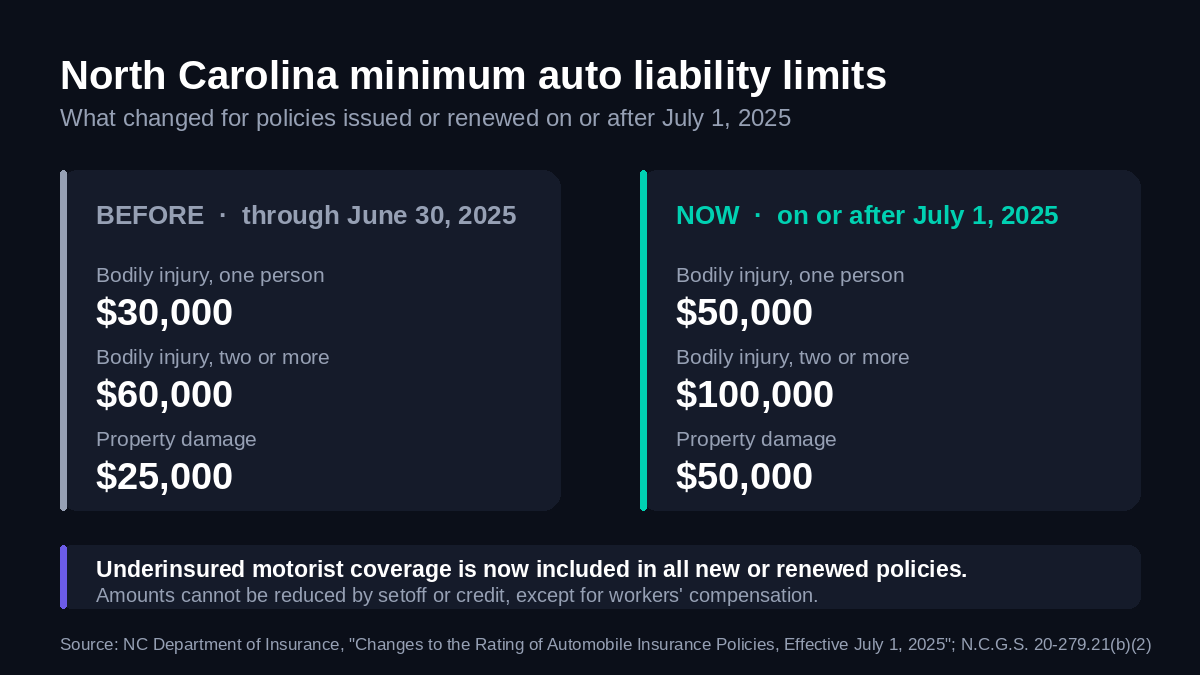
For policies issued or renewed on or after July 1, 2025, the state minimum moved from $30,000 per person and $60,000 per accident for bodily injury, plus $25,000 property damage, up to $50,000 / $100,000 / $50,000. Those figures sit in N.C.G.S. 20-279.21(b)(2), and NCDMV lists the same before-and-after numbers on its insurance requirements page.
Two other changes rode along with it. Underinsured motorist coverage is now included in all new or renewed policies rather than only higher-limit ones. And UIM amounts cannot be reduced by setoff or credit against other coverage, with workers’ compensation as the exception; where more than one policy applies, the limits combine as the sum of the highest limit available under each. The Department of Insurance also noted that anyone sitting at the old minimums can expect their premium to change when the higher limits attach at renewal.
In North Carolina, the car’s policy goes first
Coverage here attaches to the vehicle, not to the reason for the trip. Every registered vehicle in the state has to carry continuous liability insurance under G.S. 20-309, written by a company licensed to do business in North Carolina — NCDMV says flatly that out-of-state policies are not accepted. So when an employee has a wreck on a work errand in her own car, the first policy in line is hers, at whatever limits she happens to carry.
For plenty of drivers, that is the state minimum. A rear-end collision on Timber Drive with two people in the other car can move past $50,000 for one person faster than most owners expect once an ambulance ride and an emergency room visit are in the file. When the first layer runs out, the next question is who else gets named.
Getting named and getting covered are two different questions
Whether your business is legally responsible for an employee’s crash is a facts question — what the errand was, whether you asked for it, whether the person was on the clock and doing your work at the time. That gets sorted out by attorneys and sometimes a jury. Your insurance policy does not decide it.
What the policy decides is narrower and a lot more practical: if the business gets named in that claim, is there anything on your side of it to respond? Small business policies are often built around vehicles the business owns and lists — a van, a work truck, something titled to the company. A car the business does not own, does not title, and never mentioned to the insurer is a different animal. NCDOI lists “use of non-owned vehicles” among the factors that go into rating a commercial auto policy, which is another way of saying it is a rated exposure. It generally has to be on the policy to be priced, and priced to be there. Whether yours addresses it is worth checking rather than assuming.
This is not just a delivery-company problem
It is easy to file this under trucking and move on. The numbers argue otherwise. The SBA’s 2025 North Carolina profile counts 1.1 million small businesses in the state — 99.6 percent of all NC businesses — employing 1.8 million people, or 44.2 percent of the state’s workforce. Of those firms, 914,586 have no employees at all, and another 170,817 have between one and 19.
Those small-headcount shops are exactly the ones with no fleet, nothing scheduled on a vehicle policy, and people running errands in whatever they drove to work that morning. Meanwhile NCDOT recorded 284,546 reportable crashes in North Carolina in 2024, along with 115,334 injuries and 1,622 fatal crashes. A wreck does not check whose errand it was first.
NCDOI puts the general case plainly on its business insurance page: “Almost every business uses a vehicle of some type in performing some aspect of the job.”
What to actually check this month
- Write down who drives for you and when. Include the deposit run, the supply pickup, the lunch-hour trip to the print shop. If it happens twice a month, it counts.
- Pull your own declarations page and read it for whether non-owned and hired auto exposure appears anywhere. If you cannot tell, that is a fair question to bring to a licensed agent rather than guess at.
- Ask the employees who drive on your behalf what liability limits they carry. Many sit at the state minimum, which only moved to 50/100/50 for policies issued or renewed on or after July 1, 2025 — an older policy that has not renewed yet may still be at the lower figures.
- Confirm their coverage is written by a company licensed in North Carolina. G.S. 20-309 requires it for an NC-registered vehicle, and NCDMV does not accept out-of-state policies.
- Decide in writing whether staff are allowed to run business errands in personal vehicles at all, and tell them the answer. A policy nobody has been told about is not a policy.
- Look at where your liability limits top out across everything you carry, not policy by policy. The July 2025 change moved the floor, not the ceiling.
Where to read more
Our commercial insurance page covers what a business policy is generally built to do and where it tends to stop. The auto insurance page walks through the personal side — the limits your employees are actually driving on every day. And if the worry is what happens after a first layer of liability is used up, umbrella insurance is the piece that sits above the others.
Sources
- NC Department of Insurance — Changes to the Rating of Automobile Insurance Policies, Effective July 1, 2025
- N.C. General Statutes § 20-279.21, “Motor vehicle liability policy” defined
- NCDMV — Vehicle Insurance Requirements (G.S. 20-309)
- NC Department of Insurance — Types of Insurance for your Business
- U.S. Small Business Administration Office of Advocacy — North Carolina 2025 Small Business Profile
- NCDOT — 2024 Statewide Crash Profile
This article is general information about how coverage works in North Carolina. It is not advice about your specific policy. Coverage terms, limits and availability vary by policy — check your own declarations page or talk with a licensed agent before making a change.
Is your business actually covered for what you do?
General liability, workers’ comp, commercial auto, cyber — the gaps usually show up in the details. We’ll review what you carry now and flag what’s missing before a claim does.
You Insurance Agency · Garner, NC · right next door to the Post Office · Auto · Home · Life · Commercial