
Got an NCDMV Insurance Lapse Notice? What It Means and What to Do

The envelope does not look like much. It is a plain notice from the N.C. Division of Motor Vehicles with a control number on it, and somewhere in the text it says your liability insurance was terminated. Most people who get one in Garner, Raleigh or Clayton did not actually drive around uninsured. They switched carriers, sold a car, or moved a policy and something did not line up in the state’s records. The notice still starts a clock, and the clock is short.
What the notice actually is
North Carolina law says the owner of every vehicle registered in the state “shall maintain financial responsibility continuously throughout the period of registration” (N.C.G.S. 20-309(a)). Continuously is the operative word. The state is not checking whether you had coverage on the day you were pulled over — it is checking whether there was ever a gap in the record.
Insurance companies are required to tell NCDMV when a policy is cancelled or lapses. When that report comes in and nothing replaces it, NCDMV mails the registered owner a liability insurance termination notice — Form FS-5. Per NCDMV, the owner has 10 days from the date printed on the notice to respond. Ignore it and the agency can revoke the vehicle’s license plate and add civil penalties, late fees, interest and collections on top.
Why it shows up when you never went without coverage
Three situations produce most of these letters around Wake County:
- You changed carriers and the old policy’s cancellation hit the state’s system before the new policy’s confirmation did.
- You moved here from another state and kept the old policy. NCDMV is explicit that coverage has to come from a company licensed to do business in North Carolina, and that out-of-state policies are not accepted.
- You sold or parked a vehicle and cancelled the insurance while the plate was still in your name.
None of those feel like a lapse to the person living it. All three look identical to the state.
What it costs if you let it ride
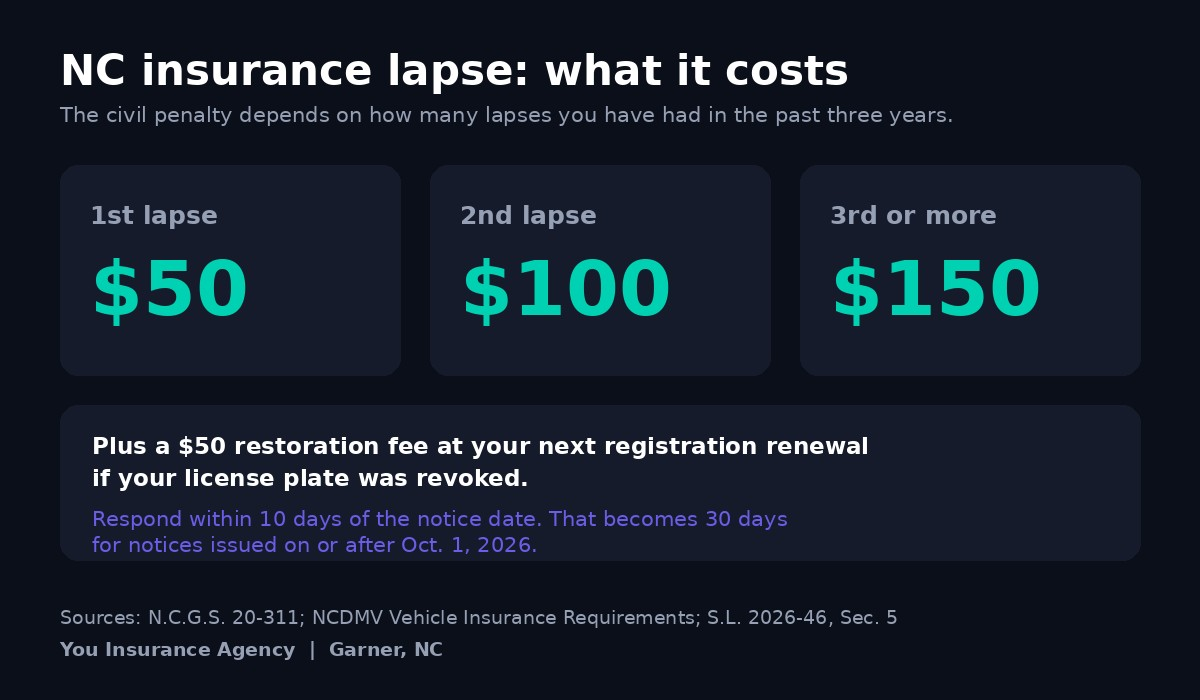
The civil penalty is set by statute and scales with your history. Under N.C.G.S. 20-311(b) it is $50 for a first lapse, $100 for a second, and $150 for a third or more, counted over the previous three years. If the plate was revoked, NCDMV also charges a $50 restoration fee at your next registration renewal. And driving a vehicle in North Carolina without the required financial responsibility in force is a Class 3 misdemeanor under N.C.G.S. 20-313(a) — a separate problem from the civil penalty.
The deadline changes on October 1, 2026
This is the part worth putting on the calendar. Session Law 2026-46, Section 5, rewrites the response window in N.C.G.S. 20-311 from 10 days to 30 days. The section becomes effective October 1, 2026, and it applies to notices issued on or after that date.
Read that last clause carefully. A notice dated in September 2026 is still a 10-day notice, even if it reaches your mailbox in October. If the date printed on the letter is before October 1, treat it as urgent, because the longer window does not apply retroactively. Ten days from the notice date is not ten days from the day you open it, and mail to a Garner address does not move any faster than the deadline.
What to actually do when one arrives
- Find the date printed on the notice, not the postmark. That is day one.
- Pull the declarations page for the vehicle in question and check the effective dates against the gap the state is claiming. Most of the time the answer is right there.
- If you had continuous coverage, call the insurance company on the policy and ask them to submit a Certificate of Insurance (Form FS-1) electronically to NCDMV. Per NCDMV, once it receives an FS-1 showing continuous coverage, it updates its records and the fines are cleared. You cannot file it yourself — the carrier does it.
- If there really was a gap, get coverage in force first, then handle the penalty. NCDMV takes lapse payments online through payments.ncdot.gov; you will need the control number from the FS-5 notice and the license plate number.
- Keep a copy of everything. If the plate was revoked, the $50 restoration fee lands at renewal, and you want the paper trail when that bill shows up.
The mistake that generates the most of these letters
NCDMV’s own guidance is blunt about it: cancel the insurance only after the North Carolina license plate has been turned in to NCDMV. Cancel first and the state sees a registered vehicle with no coverage, and the fines follow. This catches people who sell a truck on a Saturday, cancel the policy Sunday night, and get around to the tag office two weeks later. The order matters more than the timing.
It is also worth knowing that a clean insurance record feeds directly into your next registration renewal. NCDMV requires a passing state inspection no more than 90 days before the registration expires, and current insurance information is one of the items you need to renew online. A lapse flag is a bad thing to discover the week your tag is due.
While you have the declarations page out
Since most people only look at this document when something goes wrong, use the moment. For policies issued or renewed on or after July 1, 2025, North Carolina’s minimum liability limits moved to $50,000 per person and $100,000 per accident for bodily injury and $50,000 for property damage, up from 30/60/25. If your limits still read 30/60/25, that is worth asking a licensed agent about. The same continuous-coverage rule applies to anything else you have tagged in North Carolina, so if there is a bike in the garage, our motorcycle insurance page covers how that one works, and a vehicle titled to your business belongs under commercial insurance rather than a personal policy. Everything on the personal side starts at auto insurance.
Sources
- NCDMV — Vehicle Insurance Requirements
- N.C. General Statutes, Chapter 20, Article 13 (G.S. 20-309, 20-311, 20-313)
- Session Law 2026-46, Section 5
- NCDMV — Liability Insurance Help
- NCDMV — Vehicle Registration Renewals
This article is general information about how coverage works in North Carolina. It is not advice about your specific policy. Coverage terms, limits and availability vary by policy — check your own declarations page or talk with a licensed agent before making a change.
When did you last have your auto policy checked?
Rates move, and the carrier that priced best for you two years ago may not be the one that prices best now. Send us what you have and we’ll tell you honestly whether it’s still the right policy.
You Insurance Agency · Garner, NC · right next door to the Post Office · Auto · Home · Life · Commercial