
Hiring a Subcontractor in North Carolina? Get the Certificate Before They Start

A two-man crew pulls into a driveway in Garner to tear off a roof. They are not your employees — they work for the subcontractor you hired. On the second morning one of them comes off a ladder and breaks a wrist. Whose claim is that? In North Carolina, the answer often turns on a piece of paper you were supposed to collect before anyone set foot on the property.
It is one of the quietest exposures a small contractor or remodeler carries, because the trap is built out of a rule that sounds like it protects small crews.
The three-employee rule cuts both ways
The North Carolina Industrial Commission states that businesses employing three or more employees on a regular basis must carry workers’ compensation insurance or qualify as self-insured. The one headcount exception runs the other direction: an employer with one or more employees who work with or are exposed to radiation must have coverage regardless of size.
Two details catch people out when they count heads. Executive officers selected or appointed under a corporation’s charter and bylaws count as employees, so a corporation with two officers and one worker is at three. Sole proprietors, partners and LLC members are not automatically counted, though they may elect to include themselves under a policy.
Run that math on the crews you hire and you find the problem. A two-person roofing, framing or landscaping outfit is often legitimately under the line and legitimately uninsured. North Carolina subcontractor workers compensation liability does not stop there, though. It moves up the chain to the party who hired them.
What G.S. 97-19 actually puts on you
Under N.C. Gen. Stat. 97-19, any principal contractor, intermediate contractor or subcontractor who sublets a contract without obtaining a certificate — either from that subcontractor or from the Industrial Commission — showing the subcontractor has complied with G.S. 97-93 for a specified term is liable for compensation and benefits to that subcontractor’s injured employees, to the same extent the subcontractor would be. For a self-insured subcontractor, the equivalent document is a certificate of compliance issued by the Department of Insurance.
Then comes the sentence that closes the escape hatch. The statute says the liability applies “irrespective of whether such subcontractor has regularly in service fewer than three employees in the same business within this State.” A sub being too small to need coverage is not a defense for the contractor who hired them without a certificate.
Timing is the whole ballgame. The statute protects the contractor who obtains the certificate before subletting the work, for injuries within its term. Collecting it after the tear-off has started is not the same thing.
There is a safe harbor, and it is narrower than it sounds
G.S. 97-19 does not leave a contractor with no outs. A contractor is not liable to the subcontractor’s employee if the subcontractor in fact had a workers’ compensation policy complying with G.S. 97-93 in effect on the date of injury, even if the certificate was never obtained. There is also protection where the contractor did obtain the certificate before subletting and the policy later expired or was cancelled before the injury without the contractor’s knowledge.
Read those together and the lesson is the same. The first depends entirely on facts you never verified. The second only exists for the contractor who collected the certificate in the first place.
What it costs to be the uninsured one
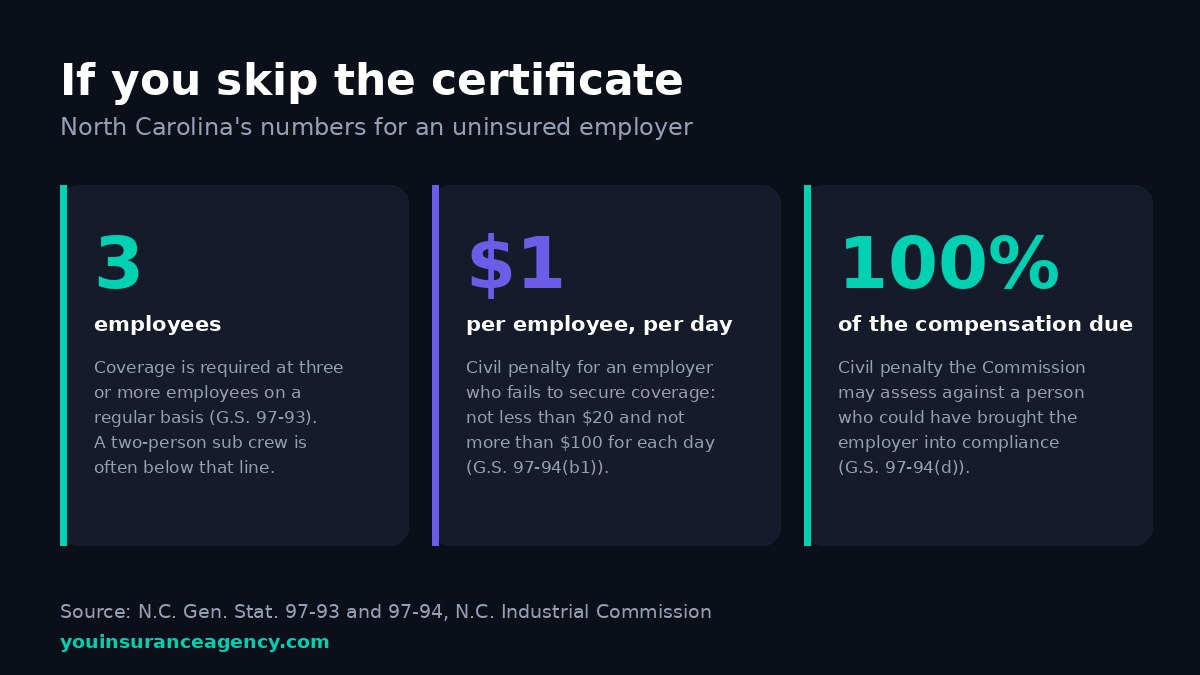
If the exposure lands on a business that should have carried coverage, N.C. Gen. Stat. 97-94 sets out what follows. An employer who refuses or neglects to secure the payment of compensation faces a penalty of one dollar for each employee, but not less than twenty dollars nor more than one hundred dollars, for each day of the refusal or neglect and until it ceases.
The criminal side is real too. An employer who willfully fails to secure coverage is guilty of a Class H felony; neglecting to secure it is a Class 1 misdemeanor. The same split applies to a person with the ability and authority to bring the employer into compliance, and the Commission may assess that person a civil penalty of up to one hundred percent of the compensation due employees injured during the noncompliance.
The Commission’s coverage search is a starting point, not proof
The Industrial Commission runs an Insurance Coverage Search System that returns employer and carrier name and address, policy number, and policy effective, cancellation and reinstatement dates — useful for a quick look at a new sub.
It is also hedged, and the Commission says so plainly: the information is not proof of, evidence of, or verification of workers’ compensation insurance. It may not reflect cancellations or reinstatements that have not been reported to the Commission or the N.C. Rate Bureau, or that were reported within the last 30 days. The Commission’s own instruction is to verify with the employer and the insurer.
One more document trap worth knowing: the Commission states that occupational accident insurance is not a lawful substitute for workers’ compensation coverage. If a sub hands over an “occ/acc” certificate, it is not the certificate G.S. 97-19 is talking about.
What to actually do before the next sub starts
- Ask for the certificate before the work is sublet, not on day three. The protection in G.S. 97-19 is tied to obtaining it beforehand.
- Read the term dates, not just the logo at the top. The statute speaks to a specified term, so a certificate that lapses mid-job leaves the back half of it bare.
- Check what kind of document you were handed: a workers’ compensation certificate, or a certificate of compliance from the Department of Insurance for a self-insured sub. An occupational accident policy is neither.
- Cross-check the sub in the Commission’s Insurance Coverage Search, keeping the 30-day reporting lag in mind, and confirm anything that looks off with the sub and their carrier.
- Collect one at every tier. If your sub brings on their own sub, G.S. 97-19 runs down the chain, and so does the exposure.
- Re-collect at renewal on long jobs, and ask to be told about a cancellation rather than finding out from a claim.
- Keep the certificates in the job file with the contract. A claim can show up long after the trucks have left, and the file is what answers it.
- If you believe a business is operating with no coverage at all, the Commission takes reports at its Criminal Investigations and Employee Classification Division, fraudcomplaints@ic.nc.gov or 888-891-4895.
Where this sits in your own coverage
Certificates are the paperwork side. The other half is what your own business carries, and that is worth reviewing with a licensed agent rather than guessing from a checklist — our commercial insurance page walks through what a small North Carolina operation typically looks at. If your crew or your subs drive for the job, ask how business use is handled on the auto insurance you already have. And umbrella insurance is the piece that sits above the underlying business policies.
None of this requires a law degree. It requires a folder, and the discipline to fill it before the first nail goes in.
Sources
- N.C. Industrial Commission, G.S. 97-19: ic.nc.gov — 97-19
- N.C. General Assembly, G.S. 97-19: ncleg.net — GS 97-19
- N.C. General Assembly, G.S. 97-94: ncleg.gov — GS 97-94
- N.C. Industrial Commission, insurance requirements: ic.nc.gov/wcinsrqmt.html
- N.C. Industrial Commission, FAQs: ic.nc.gov/faqs
- N.C. Industrial Commission, Insurance Coverage Search System: ic.nc.gov/database.html
This article is general information about how coverage works in North Carolina. It is not advice about your specific policy. Coverage terms, limits and availability vary by policy — check your own declarations page or talk with a licensed agent before making a change.
Is your business actually covered for what you do?
General liability, workers’ comp, commercial auto, cyber — the gaps usually show up in the details. We’ll review what you carry now and flag what’s missing before a claim does.
You Insurance Agency · Garner, NC · right next door to the Post Office · Auto · Home · Life · Commercial